Build Languages Your Characters Actually Speak.
A conlang workbench that goes all the way from phonotactics to full sentences. Phoneme inventories, grammar rules across nine categories, morphology, rule-based word generation, and a scanner that finds where your conlang already appears in the manuscript.
Language Management
Create and organize constructed languages with full linguistic metadata. Track family trees, define writing systems, and link everything back to your Legendry.
Language Properties
Name, endonym (what speakers call it), description, status (draft/active/extinct/proto), word order (SOV/SVO/VSO/VOS/OVS/OSV/free), and morphology type (isolating/agglutinative/fusional/polysynthetic/oligosynthetic).
Family Trees
Build parent-child hierarchies for proto-languages and their descendants. Track how languages evolved, branched, and influenced each other across your world's history.
Writing Systems
Define the script: alphabet, syllabary, logographic, abjad, abugida, or featural. Set direction — left-to-right, right-to-left, top-to-bottom, or boustrophedon.
Status Tracking
Four lifecycle statuses: Draft (in development), Active (currently spoken), Extinct (historical only), Proto (ancestral reconstruction). Filter your language list by what's actively used.
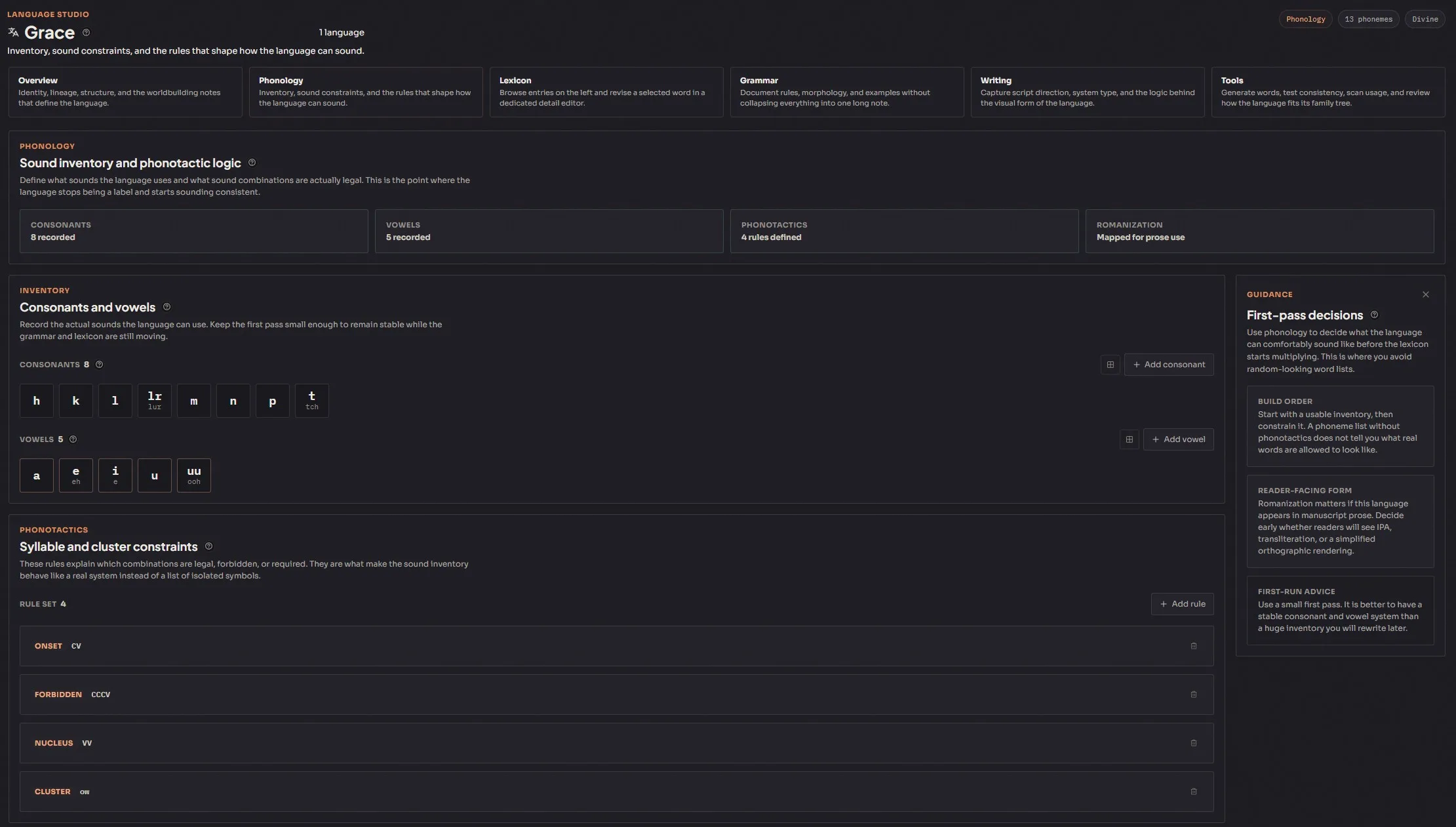
Phoneme Inventory & Phonotactics
Define exactly what sounds your language uses and how they combine. IPA support, consonant and vowel feature tracking, and rule-based phonotactic constraints.
Consonant and vowel inventories with phonotactic rules for onset, coda, and cluster constraints.
- Phoneme Inventory
- Add phonemes with IPA symbols or custom notation, romanization mappings, and type classification (consonant, vowel, diphthong). Build the complete sound system of your language.
- Consonant Features
- Track manner of articulation (plosive, fricative, nasal, etc.), place of articulation (bilabial, alveolar, velar, etc.), and voicing. Full IPA-standard feature specification.
- Vowel Features
- Height (open, close, mid), backness (front, central, back), and roundedness. Diphthong support for complex vowel sounds that glide between positions.
- Phonotactic Rules
- Define what sound combinations are legal: onset clusters, coda restrictions, forbidden sequences, required patterns. Rules use regex or template notation and enforce consistency across the lexicon.
Lexicon & Grammar Rules
Build a searchable dictionary and define grammar rules across nine categories. Every word tracks pronunciation, etymology, and part of speech. Every rule includes examples with interlinear gloss.
Rule sets, morpheme inventory, affix tracking, and first-pass grammar strategy guidance.
- Lexicon
- Each entry: word, pronunciation, part of speech (noun/verb/adjective/adverb/pronoun/preposition/conjunction/interjection/particle), translation, etymology, root word links, usage examples, and tags.
- Grammar Rules
- Nine rule categories: morphology, syntax, case, tense, aspect, mood, number, gender, and honorific. Each rule has a name, description, pattern, and annotated examples.
- Interlinear Gloss
- Grammar examples include interlinear glossing — word-by-word breakdown showing morpheme boundaries, grammatical markers, and translations aligned vertically.
- Tag System
- Tag lexicon entries and grammar rules for cross-referencing. Filter by tag to see all words related to "warfare" or all grammar rules affecting "formal register."
Morphology & Writing Systems
Define how words are built from smaller units and how they're written. Morpheme cataloging, allomorph tracking, and writing system narratives.
Morpheme Types
Catalog prefixes, suffixes, infixes, circumfixes, clitics, and particles. Each morpheme has a text, meaning, type, category, and set of allomorphs.
Allomorphs & Categories
Track variant forms of the same morpheme and organize them by category. See how the plural marker changes based on the preceding vowel, for example.
Writing System Narrative
Beyond the technical spec (type, direction), write a narrative description of the writing system — its history, aesthetics, cultural significance, and evolution.
Root Word Networks
Link derived words back to their roots. See the family tree of a single root — how one base morpheme spawned dozens of words across different parts of speech.
Word Generation
Generate candidate words that sound like they belong in your language. Two approaches: rule-based generation from your phonotactic rules, or Hawken-assisted ranking that suggests meanings and etymologies. You pick which ones enter your lexicon.
- Rule-Based Generator
- Syllable templates define the structure (CVC, CV, CVCC). Phonemes come from your inventory, filtered against your phonotactic rules. Configure word count, syllable range, random seed, and phoneme bias. Generate fifty candidates at a time, and keep the ones that feel right.
- Hawken-Assisted Ranking
- Hawken reviews generated candidates against your existing lexicon and ranks them for aesthetic consistency, plus it can propose meanings, etymologies, and usage contexts. You review the suggestions and decide which ones become real words in your language.
- Generator Settings
- Control output count, syllable range (min/max), random seed for reproducibility, and phoneme frequency bias. You run the generator, Language Studio does the phonotactic math, and the candidates stay candidates until you promote them.
Translation & Validation
Translate text using your lexicon, validate consistency against your rules, and find where your conlang words appear in your manuscripts.
Translation Helper
Word-by-word lookup against your lexicon with automatic reordering based on your language's word order. Input English, get your conlang output with each word resolved.
Consistency Checker
Validate every word in your lexicon against your phonotactic rules. Catch words that violate your own sound system — typos, legacy entries, or intentional exceptions to document.
Usage Scanner
Scan your manuscripts for conlang words and show them in context with character offsets. See exactly where and how your constructed language appears in your prose.