Your World Has Rules. Now Run the Math.
A rules engine for fiction. Define stats, write formulas with real dice notation, and run probability analysis on your magic system before a reader tells you it breaks. Works for soft magic, hard magic, superhero powers, cyberware, cultivation tiers, rulebook stat blocks — whatever structured system your fiction runs on.
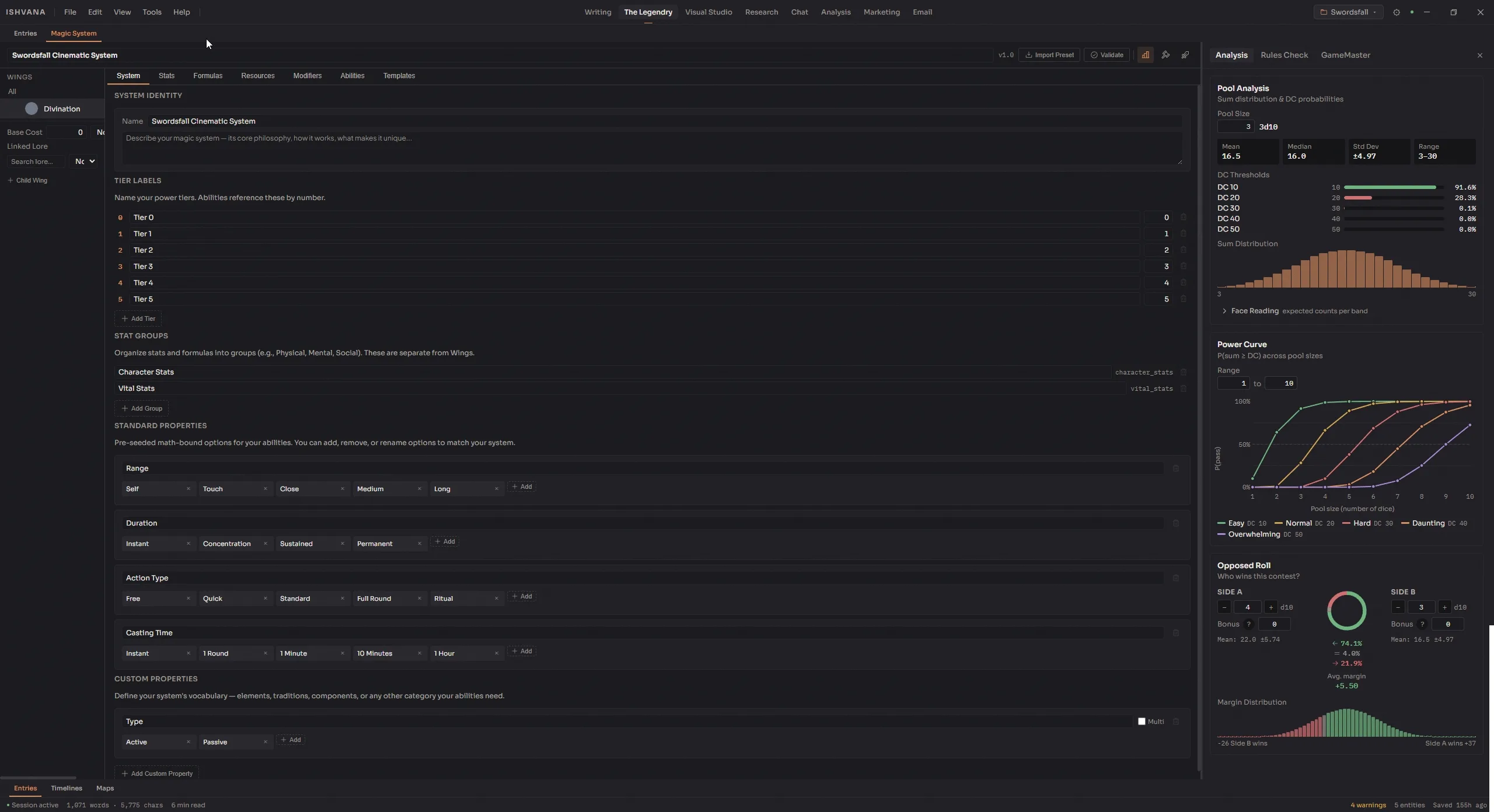
Sanderson's Allomancy has precise rules about what each metal does and how they interact. Robert Jordan's One Power has defined limits on strength, linking, and burnout. Your world has rules too — a magic system, a technology framework, a power hierarchy, combat rules. Ishvana lets you define them and actually compute with them, so you can catch the moment your rules contradict themselves before the book ships.
Define Your World's Rules
Build complete rule systems (stats, formulas, dice notation, and computed fields) in one structured editor that understands your world.
Define stats, type labels, character properties, and custom fields. Everything structured for your world's specific rules.
A Real Formula Engine
Write formulas with dice notation, reference stats by name, and see the computed results in real time. Not a text field pretending to do math. An actual expression evaluator that'll tell you if your formula breaks before you ship the chapter.
Probability distributions, power curves, and opposed roll simulations computed from your defined stats and formulas.
- Dice Notation
- Full dice expression support:
2d6+4,1d20+STR,4d6kh3(keep highest 3). Roll inline, see distributions, reference results in other formulas. - Stat References
- Formulas can reference any defined stat by name. Change a base stat and every formula that depends on it recomputes automatically.
- Computed Fields
- Define derived stats that calculate from others. AC, hit points, saving throws, spell DCs, all computed live from their source values.
- Expression Validation
- Real-time syntax checking catches malformed expressions before they break anything. Highlights undefined references, circular dependencies, and type mismatches.
Probability & Balance
Stop guessing whether your system is balanced. Actually compute it. Full probability distributions, opposed roll simulations, and power curve analysis that'll show you the breakpoints before a reader finds them.
- Pool Analysis
- Roll any dice pool and see the full probability distribution. "What are the odds of rolling 3 successes on 5d10 target 7?" Ishvana computes it instantly.
- Opposed Rolls
- Simulate contested checks between two entities. Compare probability curves to see who wins, and by how much, across thousands of simulated outcomes.
- Power Curves
- Plot how a character or ability scales across levels or stat ranges. See breakpoints, diminishing returns, and balance issues in your progression systems.
- DC Tier Analysis
- Define difficulty tiers (Easy, Medium, Hard, Impossible) and see what percentage of your characters can meet each threshold at any given point in the story.
Presets & the Rules Lawyer
Start from a proven system template or build from scratch. Then let the Rules Lawyer — the rules-checking agent — audit your work against the rules you already wrote.
| System | What It Includes |
|---|---|
| D&D 5e | Six ability scores, proficiency bonus, AC calculation, saving throws, skill checks, spell slot progression |
| Pathfinder 2e | Four-tier proficiency, three-action economy, MAP penalties, DC adjustments by level |
| Fate Core | Fate ladder (-2 to +8), aspects, stress tracks, consequence slots, skill approaches |
Rules Lawyer
The Rules Lawyer reads your Legendry entries and checks them against your defined rules.
- Stat Validation
- Checks that character stat blocks are internally consistent. If your system caps STR at 20 and a character has 23, the Rules Lawyer flags it.
- Formula Consistency
- Validates that damage formulas, skill checks, and ability calculations produce reasonable results across your cast. Catches the wizard who accidentally does more melee damage than the fighter.
- Rule Conflict Detection
- Identifies when two rules in your system contradict each other. "Fire immunity" on a character who also has "takes double fire damage"? The Rules Lawyer catches the conflict.